Where I'm from, if someone finds a dead animal in the road or in the woods, they call me.
My name is Honomi Tsuchiya, and I want to talk about how studying animals can advance the human species. I'll talk about improvements in healthcare, medicine, and even robotics.
My interest in animals and science began when I was three years old. Back then, I was only interested in princesses, dolls, and teddy bears. I was quite cute. Well one day I went to the zoo, and saw a shocking sight: at lunch time, the zookeepers were feeding the eagles. I couldn't see what they were eating, so I looked closer. Then, I saw it. Right before my eyes, a great big eagle killed and ate a baby chicken! I know! But here's the strange thing: Many little girls like me would have been shocked. But I wasn't. Instead, in that moment, I reached for my camera, and took a picture.
This event kickstarted something in me. From then on, I started buying books about animals. I was reading every night, and craving more knowledge. I couldn't get enough! When I was in fourth grade, my neighbor asked me to help him with a problem. He had captured a wild boar, and needed to dissect the body. I was overjoyed! I'll spare you the details, but from then on I began dissecting animals, making illustrations, and even got into taxidermy, or stuffing animals.
Before I knew it, people were calling me whenever they found a Tanuki carcass. I would dissect it and send the muscles, bones, and blood samples to universities around Japan. At first, it was just a professor in Ehime studying tanuki, but eventually professors from an array of different fields were thanking me for my work! Professors studying parasites, reproduction, and microplastics were using my materials for their research. This is when I realized how important animal anatomy was.
We owe alot of advancements in human healthcare to animals already. Did you know that we use horseshoe crab blood to run blood tests on humans? Or that human skin is close enough to the skin of a pig, that doctors use it to treat burn victims? And of course, a big topic these days, microplastics. Scientists are studying the microplastics in the bodies of animals, because it can help us learn what will happen to our bodies too.
Animal anatomy is also very important for robotics. Factory robots are modeled after many animals, and some prosthetic legs are made in the shape of grasshopper legs. Robots of the future will probably look like a diverse set of strange animals, not a human like the Terminator.
I still have much research to do, and a long road ahead of me, and to be honest, I don't know exactly where it will take me. But there is one thing that I want everyone to understand:
As humans, we face many problems. But whether they are problems with our health, or the environment, one thing is certain - we do not and cannot face these problems alone. Throughout our history we have improved humanity with the help of animals, insects, and nature. And as we look to math, science, politics, and other fields to help solve difficult problems, we must remember to also look to animals and nature. They still have so much to teach us.
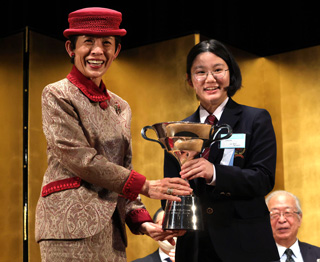
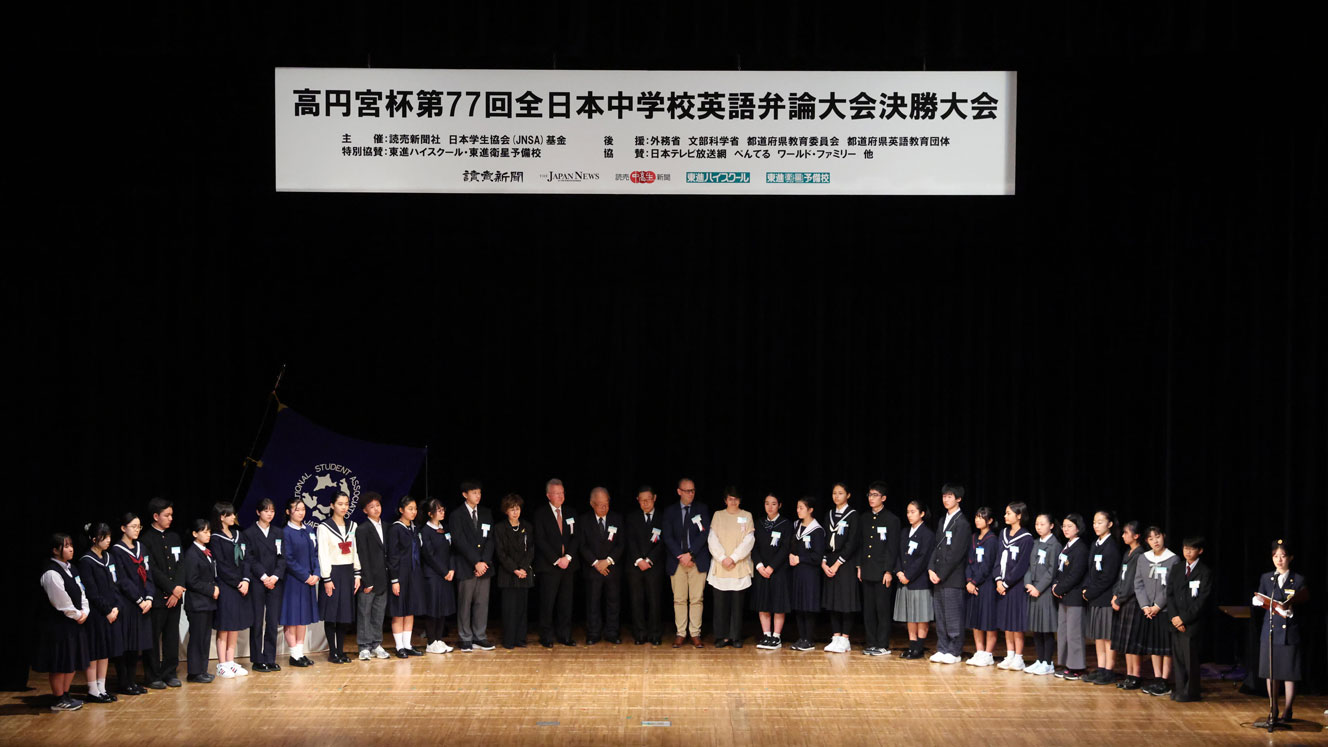
(1st Prize of the 77th Contest, 2025)
2位 ● 吉岡ブワジョル 愛実衣 さん《オーストラリア大使館賞も受賞》
鹿児島・与論中3年
「In Between, Yet Complete(ふたつの間で、ひとつの私)」
In Between, Yet Complete
At Expo 2025 in Osaka, two pavilions left a strong impression on me. The Japanese pavilion, with its focus on cutting-edge technology and a sustainable future. The French pavilion, fearlessly proclaiming love--with creativity, elegance, and irony. It wasn't a matter of liking one more than the other. For me, Japan and France are equally special. Perhaps this feeling is what people call patriotism.
My mother is Japanese. My father is French. Until the age of ten, I lived in France. Now, I live on Yoron Island, a small island of 5,000 people in southern Japan. At school, I study in Japanese. At home, I speak French. The books I read, the videos I watch--they constantly switch between two languages and two cultures.
This balance is my everyday life. One evening, I eat sushi dipped in soy sauce with my Japanese grandparents. The next morning, I share buttery croissants with my French father. To me, neither is foreign. Both belong to me. Both are my identity.
But soon, I'll face a painful choice. While many countries allow dual nationality, Japanese law does not. By the age of 20, I must choose: Japan or France. If I choose French nationality, I must live in Japan as a foreigner--no voting rights, no long-term stay without a visa. If I choose Japan, I must give up my French nationality. But how can I choose, when my life and my heart exist in both countries? Choosing one feels like rejecting the other and losing part of myself.
Sometimes, I wonder if choosing French nationality would be easier. I struggle with kanji. My textbooks are full of characters I can't read. Reading aloud in public is really painful for me. It makes me feel like I'll never truly be Japanese.
And yet, my personality feels more Japanese. I value harmony. I avoid conflict. When my French relatives articulate a strong argument in logic, I often feel overwhelmed.
So I'm not fluent enough to be fully Japanese, and not quick-witted enough to be fully French. I'm in-between. And being forced to choose feels like being told I'm not enough--no matter what I decide.
But one day, something changed. Our local high school invited a French badminton coach to run a workshop. There was one problem--no one spoke French in Yoron island. Except my family. So, I volunteered to interpret.
It was hard. Fast-paced. Technical. I was nervous. But I did my best. In the end, the workshop was a success. The coach was grateful. The students were inspired. And for the first time, I felt proud of being "in-between." I realized: I can bridge two worlds. I have a mission only I can fulfill.
Since then, I've begun to seen my future differently. Choosing a nationality doesn't erase my roots. It doesn't erase half of who I am.
Japan is changing. One in fifty children here today has a foreign parent. Add to that over three million foreign residents are in Japan. By 2065, people with some kinds of foreign background could reach 12% of whole Japanese population. That means more people like me--people balancing two or more cultures. They will face the same questions, the same struggles.
So I hope that one day, Japan will allow dual nationality. But until then, I want to study law and diplomacy--to help build a society where people like me no longer feel divided.
Because I am not incomplete. I am not torn between soy sauce and butter. I am both--together, richer in flavor.
Thank you.
(2nd Prize of the 77th Contest, 2025)
3位 ● ツン 宥憲 さん
埼玉・富岡中3年
「Should Hiroshi Be Grateful He Goes to School?(学校に行きたくない!!そんな 君に伝えたいこと)」
Should Hiroshi Be Grateful He Goes to School?
Hey Hiroshi! what's up? I asked my friend. "Urgh... my mom is going to kill me.....I got 42% in social studies oh...no. Why do I need to go to school? It's a waste of time."
Whoa, wait up Hiroshi, let's first look at a little history, I said. Even though some children in the past went to "terakoya", which were temple-based schools to learn reading, writing, and arithmetic during the Edo Period, most people still worked on farms or in shops, and formal education was not for everyone. It wasn't until the Meiji era, in 1872, that the Japanese government made school education official and available to all children. The idea was that if everyone learned similar basic knowledge and morals, Japan could become a strong and modern country. There was no reaction from Hiroshi.
But, I understood how Hiroshi and many other students felt and feel. I looked into the three most disliked subjects in junior high school in Japan and found some reasons why.
In third place was science. Students said; "Element symbols, plant names, human body structure, chemical reactions, there're too many to remember!"
Number two was...English. A student complained; "Vocabulary, grammar, pronunciation...the sentence order is so confusing. Why do I need this?"
In first place was Math! Many students moaned that: "The pace of the lessons is too fast!!!" or: "Even when I study really hard, I never get a good score." One 3rd grader said: "When will I ever need simultaneous equations?" and a first grader worried: "I'm scared that if I make just one mistake, everything will be ruined!"
I saw Hiroshi nodding. Then I asked him if he knew how many children there were in the world. He had no idea. There are currently about 2.1 billion children in the world of 15 years old or younger. But 16% can't go to school even if they want to. That's two hundred and fifty one million children that can't go to school because of; poverty, conflict, disaster, and discrimination. I asked Hiroshi if he thought he was lucky. He let out a long sigh.
I tried another angle. I told him and I'll tell you, school in Japan isn't just about subjects. Once a month, we focus on greetings and manners through "aisatsu" day. Cleaning the school ourselves teaches time management, shared responsibility, and independence. Serving lunch to classmates builds etiquette and care for others. Student council and committees promote democratic values and sometimes influence school policy. Moral education fosters empathy and civic duty, while homeroom teachers support both learning and emotional growth. It may be the best time ever to be a student.
Parents and educators abroad are often amazed by what students in Japanese junior high schools do, especially cleaning! and would love their kids to grow in a similar environment. Japan became that strong and modern country that the post-Edo period leaders dreamed of.
The name Hiroshi could be the name of any classmate I have tried to cheer up or motivate after a perceived failure. Mistakes help us start again more intelligently. I think all Hiroshis should be grateful they can go to school.
(3rd Prize of the 77th Contest, 2025)
4位 ● タカハシ アンナベアトリス さん《ワールド・ファミリー賞も受賞》
静岡・清水中3年
「The Little Interpreters(小さな通訳者たち)」
The Little Interpreters
Many people ask me, "Why do you have the last name Takahashi if you're Brazilian?" Behind that question lies a story that spans three generations and has changed my life.
In 1931, my Japanese great-grandmother was only ten years old when she immigrated to Brazil by ship, a journey that took three months. She began a new life in a small village where many Japanese people lived. The community grew, and she eventually married and had children. Ten years later, my grandfather was born, and he would play an important role in our family's story. Because my great-grandparents didn't speak any Portuguese, they depended on my grandfather, who grew up in Brazil, to be their interpreter. He became their voice in a foreign land. Years passed, and my grandfather started his own family. One of their children was my parent. That's why I have the last name "Takahashi." My roots are Japanese.
The story came full circle when my parents moved to Japan for work. I grew up here, receiving my education in Japanese schools, and soon I found myself taking on a familiar role, just like my grandfather before me. As a child, I quickly learned Japanese and became what I call a "little interpreter." I have translated school handouts and many documents for my parents. Also, I have interpreted conversations between them and others. In a way, I am connecting my family to society.
Still, life is not easy. Although we speak Portuguese at home, I am not as fluent as my parents, and I often avoid using it. At times, I get frustrated when they ask me to share in Portuguese what happens at school every day when I spend all day speaking Japanese. It is difficult for me so we have less conversations. Sometimes this leads to conflicts but they patiently wait for me to sort out my feelings. That's why I love them so much.
There are many "little interpreters" like me around you--children who help their families bridge cultural and language gaps. To all of them, I want to send a message: Yes, interpreting for our parents can feel annoying or even like a waste of time but it is also a chance to learn and to grow. Whether it is translating documents, or interpreting conversations, all of those are good for you. You gain knowledge, develop problem solving skills, build relationships, and see the world from different perspectives. I remember when I interpreted my mother's words to important people at her work event. At that time, I was impressed by the possibility of working as an interpreter who can use it as a tool to help others and convey feelings clearly.
As I try to become fluent in Portuguese, Japanese and English, I understand this journey is not just about me but also my family's legacy. From my great-grandmother who left Japan for Brazil, to my grandfather who translated for his parents, to me interpreting for mine, our family story has always been about communication and connection. I know I am not alone--there are many "little interpreters" around the world. Our struggles are real, but so are the opportunities to learn, grow, and build bridges between people. One day, I hope to use my languages not only for my family but also to connect cultures and help create a kinder, more understanding society.
(4th Prize of the 77th Contest, 2025)
5位 ● 稲津 陽向 さん
長崎・長崎大教育学部付属中2年
「Hambunko(はんぶんこ)」
Hambunko
"I hate sharing!"
That's what I used to think when I was a child. Everything-snacks, attention, love-was always divided. For me, "sharing" meant losing out, having to compromise. I envied those who could have things all to themselves. To me, my siblings were just "rivals."
I have a sister two years older than me. Her name is Saya. She's smart, runs fast, and she's also good at English and playing tennis. She makes friends easily with anyone. She was always one step ahead of me. When I entered elementary school, people called me "Saya's little sister." At first, I was happy because everyone knew me. But then, they stopped using my name. It was like I'd lost my identity. As the younger sister, I've always been "second." I never wanted to come in second place at anything. I longed for something that was mine-something where I could finally outshine my sister. I am HINATA.
So, I decided I would go to a different junior high school but join the same tennis club to surpass her. All my passion was focused on winning against her.
This summer, I had a life-changing experience in St. Paul, Minesota, America. St. Paul is Nagasaki's sister city, a place that has extended friendship for 70 years. "Sister city" in Japanese uses the kanji for older sister and younger sister, so I wondered, "which city is the "older sister" or the "younger sister"? Are they rivals, like Saya and me?"
However, I was completely wrong.
In America, my host family welcomed me like I was one of their own daughters. We shared snacks together, laughed together, and connected on a deeper level. That small act truly moved me.
"Sharing" is not about dividing things.
"Sharing" is about showing you care.
"Sharing" is about building connections and doubling joy.
It's not about taking away. It's about spreading love. I finally realized the true meaning of "sharing". My feelings for my sister changed too. My rival, the one I always wanted to beat. The truth is, she helped me grow. My siblings are not just competitors. They are people who live and support each other.
Today, the world is full of conflict and division. Sharing should be about connecting minds. However, we fight over things, hurting each other.
There's a song called "Hambunko" by MISIA, a singer from Nagasaki, that says:
"Let's share it, we can be kind."
"Let's share it, like happiness-it doubles."
The lyrics of this song sank into my heart-quietly, yet deeply. Sharing is a passionate word that has the power to change the world. I want to pass on this passion, and the meaning behind it, to the children who will shape the future of our world. A future where people are connected not by power, not by wealth, but by "hambunko"-the simple act of sharing with one another.
Thank you for listening.
(5th Prize of the 77th Contest, 2025)
6位 ● 間瀬 千尋 さん
和歌山・開智中3年
「Unapologetically Me(ありのままの自分でいること)」
Unapologetically Me
What is most important to you?" According to a survey on life values conducted by Sony Life Insurance in 2021, targeting junior and senior high school students, friends was number one.
Honestly, this slightly bothers me. Is "friendship" really that important?
There was a time when I believed so. When I was in fourth grade, I was quite popular at school and easily attracted attention - what you would call the "social butterfly" of the class.
However, in order to attract such attention, I was very conscious of my clothes, possessions, and character to avoid being disliked by others. Looking back, those days were suffocating.
At recess, I was always surrounded by classmates but I always had a sense of anxiety in the back of my mind, fearing I would lose popularity. Some people might feel that they are superior to others just because they are being noticed, while others might feel inferior simply because they do not stand out.
We see this come into play a lot. For example, when asked to form pairs in class, some people find a partner straight away, while others end up without one. In such situations, we feel what is known as the "school caste." The factors that determine this include personality, academic ability, athletic skills and so on.
In my view, the school caste is one of the most trivial things. Being bound by this invisible hierarchy, I began to lose myself more and more. I started to act according to what others expected, pretending to always be upbeat... and before I knew it, I was hiding my real self. I became afraid of letting those "fake" friends know the real me. I thought if I showed them the real me, they might not like me. This made me feel extremely anxious. So much so that eventually I stopped going to school. I believe friends should be mirrors that help us see ourselves objectively.
Unfortunately, recently, many people are obsessed with popularity as reflected on social media. People want to have many followers and put up posts and photos to gain likes and nice comments. People are afraid of being disliked by others and become upset if they don't get likes from friends or, even worse, get unfriended.
However, true friends would never suddenly cut ties over a small disagreement. That's why I believe it is essential to make friends who accept the real you.
At this point, some of you may be thinking: "What if I'm not confident that others will accept the real me?" My answer is simple: you need to work on yourself.
This may sound difficult, but it really just means mastering something you love or are good at. For me, it was studying. I became interested in English, and I learned how to express my thoughts.
That, in turn, naturally created opportunities for interaction with others. The relationships that formed when I was being true to myself became incredibly valuable. That's why I believe we don't need to force ourselves to make friends. By valuing ourselves and engaging with people honestly, we can build truly meaningful, genuine relationships.
Take care of yourself, live as you wish and above all, be true to yourself, love yourself. This is my true self. If you happen to like this version of me...great. If not...still great.
(6th Prize of the 77th Contest, 2025)
7位 ● 安西 実咲 さん
東京・学習院女子中等科3年
「The Key to a New World(新しい世界へのカギ)」
The Key to a New World
What if I told you there is a key that can take you to an amusement park, the best school, or even to space? Would you take it? This key is neither magical nor imaginary. It is English.
I am sure there are people who find studying English an interesting subject. Still, also, I hear many of my friends saying, "Living in Japan, why do we need English?" or "We are in a technology era, why can't we just use a translating machine or Apps? It's much easier and smarter." Actually, until recently, I used to think the same way. As I am making a speech in front of you, I understand that English as a subject is not easy. Today, I would like to share how my thoughts changed during my recent experience.
Born and raised in Japan, I still struggle with my English. However, my journey never started from studying the subject "English". For me, English has been a fun experience. My friends know me as a Disney lover, which is true, but to be honest, it is more than this. I have been going to Disney parks since I was 2 years old. Since then, I have been obsessed with Disney books and programs. This has nothing to do with early English education but just my preference. Whenever I met a prince or princess at the parks, we always had a little chat, danced, and even walked around holding hands, talking in English. It was my love for all things Disney that motivated me to keep learning English. This was nothing more than the saying "What one likes, one will do well." It isn't just going to Disney that sparked my deep interest in English.
When I was about 10, I read an article on a Disney Imagineer in a Japanese magazine with a small photo. "Imagineer" is a word made by Walt Disney, combining "imagination" and "engineering," and refers to those who design everything from Disney attractions to entire parks worldwide. This struck me, but at the same time, I faced a problem. There was only limited information in Japanese. Did you know? According to Visual Capitalist, over 60 percent of websites are written in English, while under 3 percent are in Japanese. Only 3 percent! Maybe this is one of the reasons that we need to understand English in this AI age. Later, when I knew how to look things up in English, I was able to find so much information and details of the work. And now, becoming a Disney Imagineer is my dream job for the future.
As a junior high school student, in May, we visited Hiroshima on a school trip. We looked back at Japan's history and rethought what peace means to us. In advance, we researched and deepened our knowledge and understanding. My teacher said my report was interesting for including both Japanese and American perspectives at that time. It made me realize that what I have been doing naturally was something unique. When I saw many people from all around the world visiting the Peace Museum, reading the English captions with serious expressions on their faces, I noticed something I did not know before. Being familiar with the language is not only for communicating or for exams, but can also enhance understanding and let us see things from a different angle.
Language will lead you to a wide range of possibilities and give you the strength to challenge. So, let's not limit and underestimate ourselves because of little mistakes. We don't learn English to impress. We learn how to express ourselves. It's about expressing who you are and opening doors to a new world with your uniqueness. If you are a little scared to communicate in English, just type in your fave's name or anything you are interested in knowing. English is one of the tools to connect and expand your horizons. And this is why I believe English is a key to a New World.
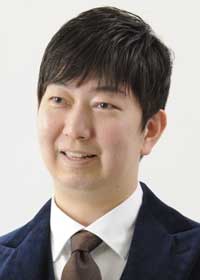
特に印象的だったのは、スピーチの序盤に用いられた"even"の使い方です。「早めにテーマを伝える」という英語スピーチの王道を守りつつも、まるで連続ドラマを見ている時の「先が知りたい」という気持ちを呼び覚ましてくれます。 I'll talkabout improvements in healthcare, medicine, and even robotics. But first, let's rewind. (私は医療、医学、さらにはロボット工学の進歩について話をします。でもその前に、少し話を戻しましょう)この even は「~でさえも」の意味で、意外性のある例を出す時に使い、スピーチでは非常に印象に残ります。そして、 Let's rewind. で個人のエピソードに話を戻すのも、メリハリがあって上手な展開です。
土谷さんのエピソードのインパクトは一味も二味も違います。例えば、 At first, it was just a professor in Ehime studying tanuki, but eventually professors from an array of different fields were thanking me for my work! (最初は、タヌキを研究している愛媛県の教授だけでしたが、やがて全く違う分野の教授たちまでが、私の解剖に感謝してくれるようになったのです!)この at first は「最初は~だった。しかし、~だった」と内容の変化の対比がつけられる表現です。
最後のメッセージは現代社会への呼びかけになっています。
Throughout our history we have improved humanity with the help of animals, insects, and nature. And aswelook to math, science, politics, and other fields to help solve difficult problems, we must remember to also look to animals and nature. They still have so much to teach us. (私たちは歴史を通して、動物や昆虫、そして自然の力を借りながら人類を発展させてきました。そして、私たちが難しい問題を解決するために数学や科学、政治、その他の分野に目を向けるとき、動物や自然にも目を向けることを忘れてはなりません。彼らからは、まだまだ学ぶべきことがたくさんあるのです)